

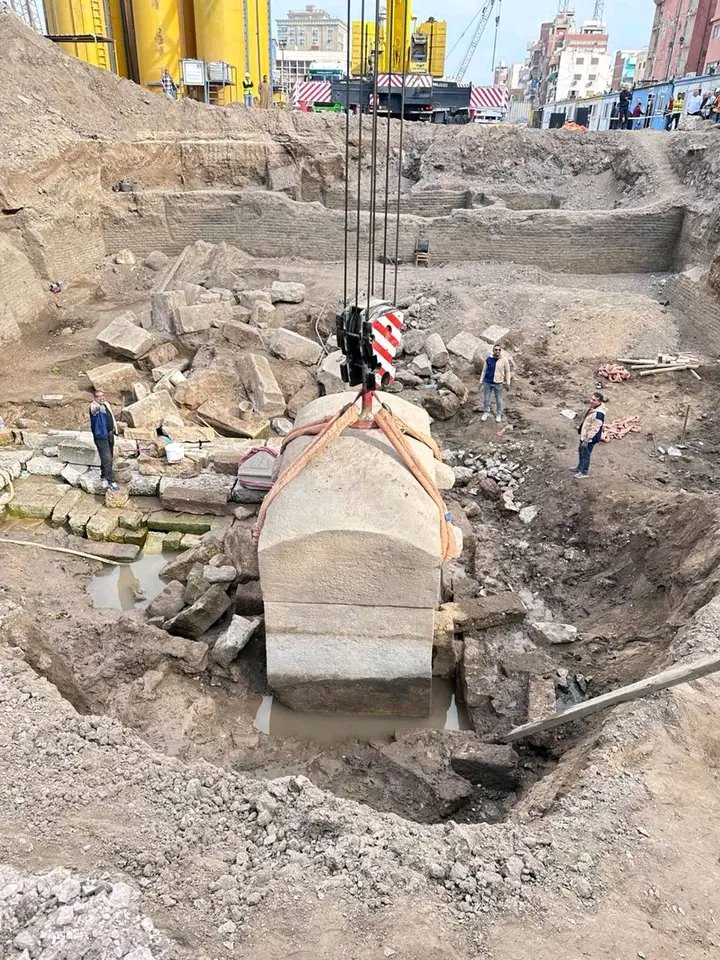
A recent archaeological discovery in Egypt has captivated the world, as experts unveil a colossal 60-ton black granite sarcophagus that could hold answers to some of ancient Egypt’s deepest secrets. Unearthed in the city of Alexandria, the massive structure is believed to be one of the largest and most enigmatic sarcophagi ever found in the region.
Measuring approximately 9 feet long, 5 feet wide, and 6 feet tall, the sarcophagus has stunned researchers not only due to its size but also because it has remained completely sealed for over 2,000 years. Found during construction work beneath a residential building, the coffin was buried nearly 16 feet underground. Its discovery immediately drew attention due to its unique characteristics and untouched condition.
Nearby, archaeologists also discovered a massive alabaster head, believed to represent the individual buried inside. This has led to widespread speculation regarding the identity of the person entombed. Could it be a forgotten pharaoh? A wealthy noble? Or perhaps someone with powerful ties to ancient royalty? These questions have ignited global curiosity, sparking renewed interest in Egypt’s rich and mysterious past.
What makes the find even more intriguing is its location—Alexandria, a city with deep historical ties to Alexander the Great and ancient Greek influence. Some enthusiasts theorized the sarcophagus might even be linked to Alexander himself, though experts have advised caution before jumping to conclusions. Egyptologists stress the importance of thorough scientific analysis and preservation efforts before making definitive claims.
The weight of the sarcophagus has posed significant logistical challenges. Moving and opening the artifact without damaging its contents has required meticulous planning and cutting-edge equipment. Despite the difficulties, the team has remained determined, driven by the possibility that the sarcophagus could contain rare relics, mummified remains, or inscriptions that offer new insights into Egypt’s complex history.
Upon opening the sarcophagus, archaeologists found the remains of three individuals submerged in reddish-brown liquid, which was initially believed to be sewage but is now thought to be a mixture of decomposed organic material. The discovery quashed more fantastical theories, but it added a new layer of mystery—who were these individuals, and why were they buried together in such an enormous coffin?
DNA testing and radiocarbon dating are currently underway to uncover the identities and time period of the remains. Meanwhile, historians and researchers are poring over details, trying to piece together the story behind this monumental tomb. Although the find may not be tied directly to royalty, it still holds immense archaeological and historical value.
This extraordinary sarcophagus has not only added a fascinating chapter to Egypt’s archaeological record but also reminded the world of the countless secrets still buried beneath its sands. With every new discovery, Egypt continues to draw attention from scientists and history enthusiasts alike, each hoping to get closer to understanding the marvels of one of the most influential civilizations in human history.